Jekyll2026-04-06T12:57:49+01:00http://localhost:4000/feed.xmlAerial EdgeAerial Edge founded in 2007 is Glasgow's circus school. Developing people through circus.
Handstands2024-10-02T00:00:00+01:002024-10-02T00:00:00+01:00http://localhost:4000/events/2024/10/02/handstandsHandstands aren’t just the definition of cool by many people’s standard, and a foundation stone of acrobatics. They are also a powerful package of portable workout and mindfulness.
Putting your weight on your arms may seem daunting at first, but each of the steps towards holding a handstand is a wonderful way to build your upper body strength. Plus you’ll find that your confidence and self-esteem grow too.
Handstands have many aspects that can be practiced in a gym, in your front room, at the park, on a beach or almost anywhere.
Achieving each step towards a hardstand and the challenges associated with them creates a great sense of accomplishment and improves your body awareness.
I also find practicing them improves my focus, because I need to be calm to balance and focus on the details. I find it akin to mindfulness because it can be frustrating but getting frustrated makes it worse. I need to remember to breathe, be calm, grounded and try again.
I enjoy the puzzle of balance – keeping the body in alignment to balance. There is always something that can be improved, and new transitions to learn. The journey is endless and wonderful.
#### Common myths
You need a really strong core for handstands
You need core stabilisation rather than strength, but if everything is in alignment, the core stabilises. It’s similar to standing on one leg. You do not need to have a really strong core, you just need to learn how to control it and where adjustments in balance can be corrected.
You are too old to learn
You are never too old to learn! Many of my adult students are over 50.
Sometimes people think we need to learn handstands when we are young, perhaps because of the physicality.
It can be really empowering to learn something acrobatic when you are older. There are many adaptations we can make to drills and exercises to make handstanding accessible for lots of people.
You need upper body strength to start learning a handstand
You will gain strength as you learn. The initial exercises are very simple. For example, can you do a plank? Can you do a plank with your feet on a chair?
#### Technique tips
External rotation in your shoulders will help to put your shoulders in the correct position
External rotation of the shoulders means that your shoulder blades separate rather than squeezing together.
If your arms are above your head, you want to rotate your arms so that you try to hide your armpits from someone standing next to you. Your inner elbows will face towards each other and your thumbs face the back. This helps stabilise your shoulders.
Breathe, and focus on your hands balancing
Don’t worry about your legs wobbling or your core collapsing, put your attention into your hands.
Holding your breath doesn’t help, but many people do it without thinking about it. Breathing evenly helps you focus and when you are focused on your hands, you’re going to hold your position better.
Set your shoulders in the correct position before you invert
The correct position is with external rotation (see above) and slight elevation. Setting your shoulders up with external rotation before you invert is better than trying fix it when you are already upside down.
#### Handstands workshop Saturday 26th October
We will be looking at changing shape in handstand and preparations for one-arms, maintaining balance while you change the shape of your handstand.
We will also focus on straddle to straight and return, tuck to straight and return, as well as side bends and back bends in the handstand.
For this workshop ideally you should ideally be able to:
- Hold a straight and straddle handstand comfortably for 10 seconds.
<a href="https://goteamup.com/p/3751555-aerial-edge/courses/108615/" target="_blank" class="button small">Book Workshop</a>
#### Hand-to-Hand Workshop Saturday 26th October
We will be looking at pitching techniques for bases and flyers
The base squats with their hands ready for the flyer to step into, and their elbows are usually touching the thighs. The flyer will step into the base’s hands and the base will give the power for the flyer to jump, leave the base’s hands then be caught by the base. The end position with will be feet-to-hand with base and flyer facing each other.
This will work towards pitch-to-catch and pitch-half-turn
The start is the same as pitch-to-catch but instead of leaving the base’s hands, there will be a half turn with the base holding one foot as the flyer turns. The end position will be foot-to-hand with base and flyer forward.
Improving hand-to-hand, and foot-hand, and preparations for one-arms
Tempo in foot-to-hand and hand-to-hand. Tempo is the start of any dynamic tricks. For example, a handspring where the flyer will start in a hand-to-hand handstand, there will be a tempo and the flyer will do half a somersault to land in foot-to-hand. The power for this move is generated by the base.
It is important to get the timing and technique for both tempo in handstand and foot-to-hand as many dynamic tricks can evolve from this.
For this workshop you will ideally be able to:
- Stand on shoulders comfortably
- Stand in hands laying and confident to try standing
- Flyers should be able to jump into a handstand through a straddle, either on the floor or with a base laying on the floor
<a href="https://goteamup.com/p/3751555-aerial-edge/courses/108615/" target="_blank" class="button small">Book Workshop</a>Tamzen MouldingHandstands aren’t just the definition of cool by many people’s standard, and a foundation stone of acrobatics. They are also a powerful package of portable workout and mindfulness. Putting your weight on your arms may seem daunting at first, but each of the steps towards holding a handstand is a wonderful way to build your upper body strength. Plus you’ll find that your confidence and self-esteem grow too. Handstands have many aspects that can be practiced in a gym, in your front room, at the park, on a beach or almost anywhere. Achieving each step towards a hardstand and the challenges associated with them creates a great sense of accomplishment and improves your body awareness. I also find practicing them improves my focus, because I need to be calm to balance and focus on the details. I find it akin to mindfulness because it can be frustrating but getting frustrated makes it worse. I need to remember to breathe, be calm, grounded and try again. I enjoy the puzzle of balance – keeping the body in alignment to balance. There is always something that can be improved, and new transitions to learn. The journey is endless and wonderful. Common myths You need a really strong core for handstands You need core stabilisation rather than strength, but if everything is in alignment, the core stabilises. It’s similar to standing on one leg. You do not need to have a really strong core, you just need to learn how to control it and where adjustments in balance can be corrected. You are too old to learn You are never too old to learn! Many of my adult students are over 50. Sometimes people think we need to learn handstands when we are young, perhaps because of the physicality. It can be really empowering to learn something acrobatic when you are older. There are many adaptations we can make to drills and exercises to make handstanding accessible for lots of people. You need upper body strength to start learning a handstand You will gain strength as you learn. The initial exercises are very simple. For example, can you do a plank? Can you do a plank with your feet on a chair? Technique tips External rotation in your shoulders will help to put your shoulders in the correct position External rotation of the shoulders means that your shoulder blades separate rather than squeezing together. If your arms are above your head, you want to rotate your arms so that you try to hide your armpits from someone standing next to you. Your inner elbows will face towards each other and your thumbs face the back. This helps stabilise your shoulders. Breathe, and focus on your hands balancing Don’t worry about your legs wobbling or your core collapsing, put your attention into your hands. Holding your breath doesn’t help, but many people do it without thinking about it. Breathing evenly helps you focus and when you are focused on your hands, you’re going to hold your position better. Set your shoulders in the correct position before you invert The correct position is with external rotation (see above) and slight elevation. Setting your shoulders up with external rotation before you invert is better than trying fix it when you are already upside down. Handstands workshop Saturday 26th October We will be looking at changing shape in handstand and preparations for one-arms, maintaining balance while you change the shape of your handstand. We will also focus on straddle to straight and return, tuck to straight and return, as well as side bends and back bends in the handstand. For this workshop ideally you should ideally be able to: Hold a straight and straddle handstand comfortably for 10 seconds.Why we all need to be the class clown2024-08-21T00:00:00+01:002024-08-21T00:00:00+01:00http://localhost:4000/programmes/2024/08/21/why-we-all-need-to-be-the-class-clownAt certain points on a Monday and Friday, what you encounter when you walk into Aerial Edge may cause you to turn back and check the door, to see if it’s some kind of wardrobe-to-Narnia portal to another world.
But no. It’s just the clowning class for the full-time students.
You might find a bunch of people sitting on the floor staring intently into each others’ eyes while chattering very loudly, passionately, and in an absolute gibberish language.
So what’s going on? Why do we feel it’s important to teach clowning – apart from the fact that it’s a highly respected circus art in its own right?
Instructor Andrew Simpson says: “In my view, it’s important because clowning is all about the connection and complicity with the audience and with yourself as a performer, and with your partner if you have one on stage.”
That’s one of the reasons the students get so animated when discussing something in gobbledegook to each other – they are learning that you don’t need words to make a connection with people, and to communicate with them.
And in many other forms of performance, creating a connection with the audience is a key skill which transforms an act from a series of technically brilliant moves to a shared experience which has an audience enthralled.
Through clowning classes, a student can learn this skill of connection regardless of which circus art they are performing for a live audience.
Andrew says: “The clown is always thinking ‘How is this landing? How is my connection with the audience?’
“They aren’t in their own world like an acrobatic performer who is not looking at you. The clown always checks, they will look directly at the audience as if saying, ‘Oh, there you are!’ And that direct connection, that eye contact, is really important.
“Sometimes with a technically brilliant circus act, someone comes on and does their thing wonderfully well, yet there’s almost a sense of asking yourself ‘Do I need to be here?’ But if I feel seen and they feel seen, a different thing happens.
“I think that’s why people still go to live performance even though there’s TV and film, there’s that indescribable magic, when you’re in a room with people.”
This ability to connect with the audience also teaches you the ability to adapt if things go wrong, or if the audience isn’t responding the way you anticipated.
“You may have a core act but each moment is different with each audience – it might land differently, so you give yourself room to improvise.”
For this and other reasons, Aerial Edge Founder Mark Gibson believes that clowning is an very useful modality for creating any kind of act.
He says: “We want to expose students to different ways of creating acts, and clowning is one of those modalities that we use. Some other modalities might be physical, choreography-based involving music with movement, some theatrical. They are all very much related to inspiring people in different ways to create art.”
The silliness of clowning goes beyond the fun that is central to the Aerial Edge training approach. Silliness generates laughter which breaks down barriers, releases inhibitions and in so doing reduces the pressure that some students put on themselves when they are working hard on their technical expertise.
Andrew says: “A lot of circus work requires you to be very skilled. It’s very technically demanding, because obviously if you don’t do it right, it’s dangerous.
“Clowning and theatre games are really good to get in touch with the softness, the lightness, the silliness…and the freedom that comes with it.
“That silliness and the play are really important. You begin to see people on a different level when you play with them. You can see the fire, the spark in their eyes and you can understand people in a different way.”
Laughing together helps to get you working together collaboratively in all circus arts, and helps to generate the deeper trust that’s needed for partner acrobatics, for instance.
So bringing students together in silliness helps feed into the wider aims of creating an imaginative and confident performer – and one who is prepared to make mistakes in order to learn from them.
“The clown is like the person in all of us who’s a bit lost, who makes mistakes…just like we all make mistakes,” says Andrew.
“In our culture, we’re taught to hide our mistakes, cover them up out of embarrassment. Clowns make mistakes all the time but they live in this joyful energy. Terrible things happened to Charlie Chaplin or Jackie Chan, but they just keep going.
“The clown is the one the audience understands. The audience maybe can’t do all the amazing things that the acrobats can do. It’s about sharing what’s going on.”
So it’s a serious business, clowning.
But as Andrew says: “Clowns take things very seriously. But maybe the things they take seriously are a bit silly.”KayAt certain points on a Monday and Friday, what you encounter when you walk into Aerial Edge may cause you to turn back and check the door, to see if it’s some kind of wardrobe-to-Narnia portal to another world.The magic and mysterious draw of the rope2024-08-15T00:00:00+01:002024-08-15T00:00:00+01:00http://localhost:4000/classes/2024/08/15/the-magic-and-mysterious-draw-of-the-ropeOn the face of it, rope may seem like the least interesting of all the circus apparatus. Yet its unassuming simplicity is its magical complexity.
“When I look at it, I find there are so many things that can be done with it, so many different ways to move on it, so many different shapes, different parts you can hang off and different things the rope itself can become, so it feels like it has a lot of room for exploration,” said Freya Pellie (@pelliefey).
Freya, who has performed and taught across the UK including our own Easter Edge, transitioned from trapeze to rope for practical reasons, and because rope was so compelling, it became one of their main disciplines, alongside hoop and straps.
“I was advised to do rope to build strength and I was interested in doing something outside of gender norms. At the time, it was seen as one of the less feminine disciplines although now there are a lot of strong rope women who are hugely inspiring.”
Freya recommends training in a vertical-based apparatus like rope and a bar-based apparatus like hoop or trapeze.
“It helps me, to bring in different material and approaches, and I think it’s really helpful for play and innovation in your preferred apparatus if you can bring in skills, ideas and techniques from other apparatus,” they said.
“There is some overlap from being on the trapeze ropes. Rope can feel more daunting than hoop or trapeze where you can sit down, but once you learn your first few locks and rest positions, it can open up a load of different options. Then when you’re working on trapeze or hoop, there are bits of rope technique that can be brought in.
“I spent a long time trying to make the biggest knot and the biggest shapes, then focusing on how minimally I could be wrapped. Then I was bringing spinning from hoop into rope.”
Max Dunway (@max_dunway) has also been seduced by rope, having started the Aerial Edge four-week Intensive Course with experience mostly in trapeze and straps.
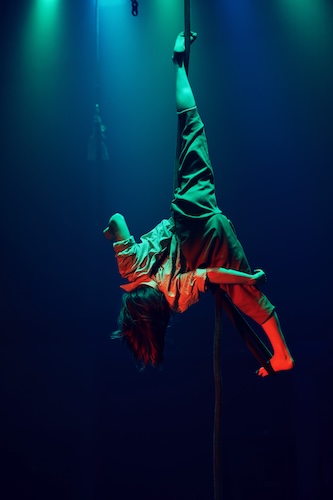
Their performance at the end of that course was in straps, but they’d been introduced to rope and despite a bad start, a slow-burning relationship with it began.
“I hated rope at first,” they said, “It was awful, I despised it – it was the worst thing ever in my life, I was thinking ‘What are you doing to me?!’
“I couldn’t do the things I wanted to do, I was clunky, I wasn’t strong enough.”
Max went on to the four-month Foundation Course and their final performance was rope – they were committed.
And now, after a successful rope audition, Max is off to study it for a year at Creat circus school in Valencia, Spain.
What happened?
“I think I was ready for a change, and there were some cool rope instructors, Bara and Nea, on the two full-time Aerial Edge courses.
“I began to really enjoy the flow aspect of rope, which is very different to straps.”
Max plans to maintain straps and acrobatics alongside rope, and go from Spain to Montreal or Quebec in Canada, then become a pro performer in ensemble productions, with perhaps some solo passion projects emerging on the side.
Like Max, Freya fell in love with rope over time, and now both are devoted to it.
For Freya it was grip strength that was the challenge; for Max it was upper body strength.
The process of gaining the skills developed their love for rope.
Freya said: “I felt it was full of possibilities. I liked that you could swing around bits of it, that you can could the rope itself to make shapes, and I liked the cleanness of it.
“I love it when you can tie yourself up in a big knot so it looks like there’s lots of things holding together, then you move all of it just falls away. For an audience, visually that’s quite enjoyable to watch.
“I also liked the practicality of not having to stress about rigging height when I was in different venues! Obviously, there are benefits to having a longer rope but it’s more versatile than trapeze.”
Max said: “Rope has a perceived high barrier to entry, like straps, because you need that upper body strength. But I would still say to people to try it.
“I think when I was able to dead hang it was a turning point. I felt safer – there’s no bar to sit on and you’re not locked in.
“The thing I like most is the movement quality, it’s really beautiful. You don’t need a bunch of moves, you can mess about and you can still really hone your skill to a really high technical level.”
And as for the inevitable comparison to silks?
Most people say there is no comparison.
“I don’t know why people like silks,” said Max.
Freya said: “I’m less into silks.”
And Aerial edge rope and silks instructor Nea Kunnari said: “There are some similarities but ultimately rope is a whole thing of its own.”KayOn the face of it, rope may seem like the least interesting of all the circus apparatus. Yet its unassuming simplicity is its magical complexity.The Aerial Edge 4 essential mobility principles2024-07-26T00:00:00+01:002024-07-26T00:00:00+01:00http://localhost:4000/programmes/2024/07/26/four-essential-mobility-principlesWanna be your best circus self? Course you do! Then you need to know about the four mobility principles that we consider to be essential.
We embed these practices into the Aerial Edge full-time courses because we’ve seen over time how they develop our professional students' circus abilities, and help to protect them from injuries.
Anyone can use these four principles to make the most of their talents and skills.
The goal is not just to achieve general flexibility but to meet the specific and varied demands of circus disciplines, such as aerial arts, contortion, acrobatics, and flow arts.
Improving mobility for circus arts is a multi-faceted approach, given the diversity and physical demands involved. This is definitely true for our full-time students, because our courses offer a broad range of arts, and it’s true for anyone even if you’re focused on one art.
Here are the four key objectives that we have found to be essential to improve your ability for circus arts.
### Increase Range of Motion (ROM)
Improving the Range of Motion in major joints such as shoulders, hips, knees, and ankles, and specific muscle groups, is necessary to perform many of the actions required for circus arts.
Increasing ROM is also the most obvious objective in flexibility. By improving hamstring or hip adductor range of motion, you move towards a split. Improving shoulder range of motion means you get better at the building blocks of aerial technique, such as skinning the cat, handstands, bridges or walkovers.
These are often why people come to flexibility training in the first place. The most effective types of exercise to improve range of motion is passive flexibility or PNF (contract/release) stretching.
### Strengthen the end ranges
The importance of end-range strength cannot be overstated!
There is a big difference in strength between holding a split on the floor where your hips are fully supported, and maintaining a split in the air on silks, for example. In that situation, the muscles and connective tissue near the end of your range of motion may have to support forces well in excess of your own body weight.
If you focus only on stretching and lengthening your muscles, they won’t be strong enough to maintain the posture or move. You could easily drop into extended splits and injure yourself.
End-range strength is a specialised form of conditioning that focuses on enhancing muscular strength at the extreme limits of your range of motion. That’s where most injuries of this type occur.
During tumbling, the impact forces applied to a performer's body have been recorded at 5 to 14 times body weight. Many of these movements, such as a back handspring, apply force at or near the end ranges of motion.
By fortifying the muscles and connective tissues at their most vulnerable points of extension or flexion, you can better safeguard against the overstretching injuries that are common in high-mobility disciplines.
### Build agonist strength
Agonist and antagonist muscles work in pairs to create movement around a joint, and maintain the joint’s stability.
Agonist muscles are the prime mover of an action. They contract (shorten) and the antagonist muscle on the other side responds by relaxing and lengthening (ie stretching) to allow the movement to occur.
When you flex your arm with a bicep curl, for instance, the bicep contracts and shortens, making it the agonist muscle, and the tricep relaxes and lengthens, and is therefore the antagonist.
Then, when you bring your arm back to a natural position, your bicep is relaxed (the antagonist muscle), and the tricep is contracted (the agonist).
The key thing is to make sure that the muscle that’s lengthening/stretching is fully supported by the contracting muscle. That means the contracting muscle needs to be strong enough.
So if you want to lift your leg into a standing split or high kick, the agonist would need to be strong enough to pull the leg into that position, and to keep the antagonist muscle safe by being strong enough to support it while it’s stretched to its full extent.
### Train across all angles
If you only train your flexibility in one line, you will be prone to injury whenever you move off that line. As much as we’d all like to perform our moves with perfect lines every time, the fact is that any number of factors can throw us off that line.
Hips and shoulders can move through multiple angles, so it is important to train all of the angles of rotation effectively.
The shoulders are a good example of how force is applied across multiple angles, in techniques such as dislocations, or skinning the cat.
### Be your best self
An effective mobility programme should include all four of these elements to ensure longevity in training, to reduce injuries, and, more importantly, to increase your individual capability. You'll also notice that only one out of four of these principles would normally be considered "flexibility" training, in circus we need a to look at building strength in partnership with flexibility.
If you want to set up a personalised programme, we can certainly walk you through that. Ask info@aerialedge.co.uk, come to flexibility or conditioning class, or chat to Mark in the space.MarkWanna be your best circus self? Course you do! Then you need to know about the four mobility principles that we consider to be essential. We embed these practices into the Aerial Edge full-time courses because we’ve seen over time how they develop our professional students’ circus abilities, and help to protect them from injuries.Why excellence is not extraordinary2024-07-10T00:00:00+01:002024-07-10T00:00:00+01:00http://localhost:4000/philosophy/2024/07/10/why-excellence-is-not-extraordinaryExcellence in performance is not extraordinary.
Outstanding performance is actually a combination of many small skills or activities, whether we mean performance as in a beautiful act on stage, or as in how well how well we’re executing our actions acrobatically or athletically.
Each small skill is learned, or discovered by chance, and has been practiced until it’s a habit. They are then are combined to form a complete whole.
There is nothing exceptional or superhuman in any one of those actions; the only important thing is that they are done consistently and correctly.
In combination, they produce excellence.
When a circus artist develops their mobility, it improves their acrobatic ability as well as their performative lines and makes them resilient to injury.
Add to that strength conditioning focused on your needs, training in a movement practice such as dance, and training in act creation, and you get a ‘skills stack' which synergistically progresses you towards excellence.
A firm foundation of physical mobility, strength training, nutrition, recovery and sustainable training practice allows you to build on your skills stack with a new layer of circus technique training, then a layer of movement practice, then act creation.
Even considerations of costume make a difference to the end movements.
Each experience has its own intrinsic value, and is compounded by the different aspects of your whole skills stack. Hence learning different circus arts also feeds into your overall progression.
Each of these elements may seem small in itself, but they allow each performer to train and move better with less stress on their body and a higher chance of longevity in their career.
Learning and consistently practising all these skills together is what develops excellence in performance.
Training in areas beyond your preferred circus discipline builds a wider ability – just as rugby players train much more than running in a field with a ball, and swimmers train outside the pool.
Working on flexibility, conditioning and movement practices like dance acro will add to your capability. Professional courses include these as a base for a reason – they enable students to perform better in their chosen skills, whether it is aerial or ground-based acrobatics.
The little things really do count!
Photo credit: Max CrawfordMarkExcellence in performance is not extraordinary.How handstand heroes are made2024-04-04T00:00:00+01:002024-04-04T00:00:00+01:00http://localhost:4000/events/2024/04/04/how-handstand-heroes-are-made**Workshops summary:**
- Hand-to-Hand and Acrobalance on Friday 26th April – [book here](https://goteamup.com/p/3751555-aerial-edge/e/70641481-group-acrohand-to-hand-workshop/)
- Advanced Handstands on Saturday 27th April – [book here](https://goteamup.com/p/3751555-aerial-edge/e/70641487-advanced-handstand-workshop/)
- Cradle Basics on Saturday 27th April – [book here](https://goteamup.com/p/3751555-aerial-edge/e/70641485-flying-trapeze-cradle-workshop/)
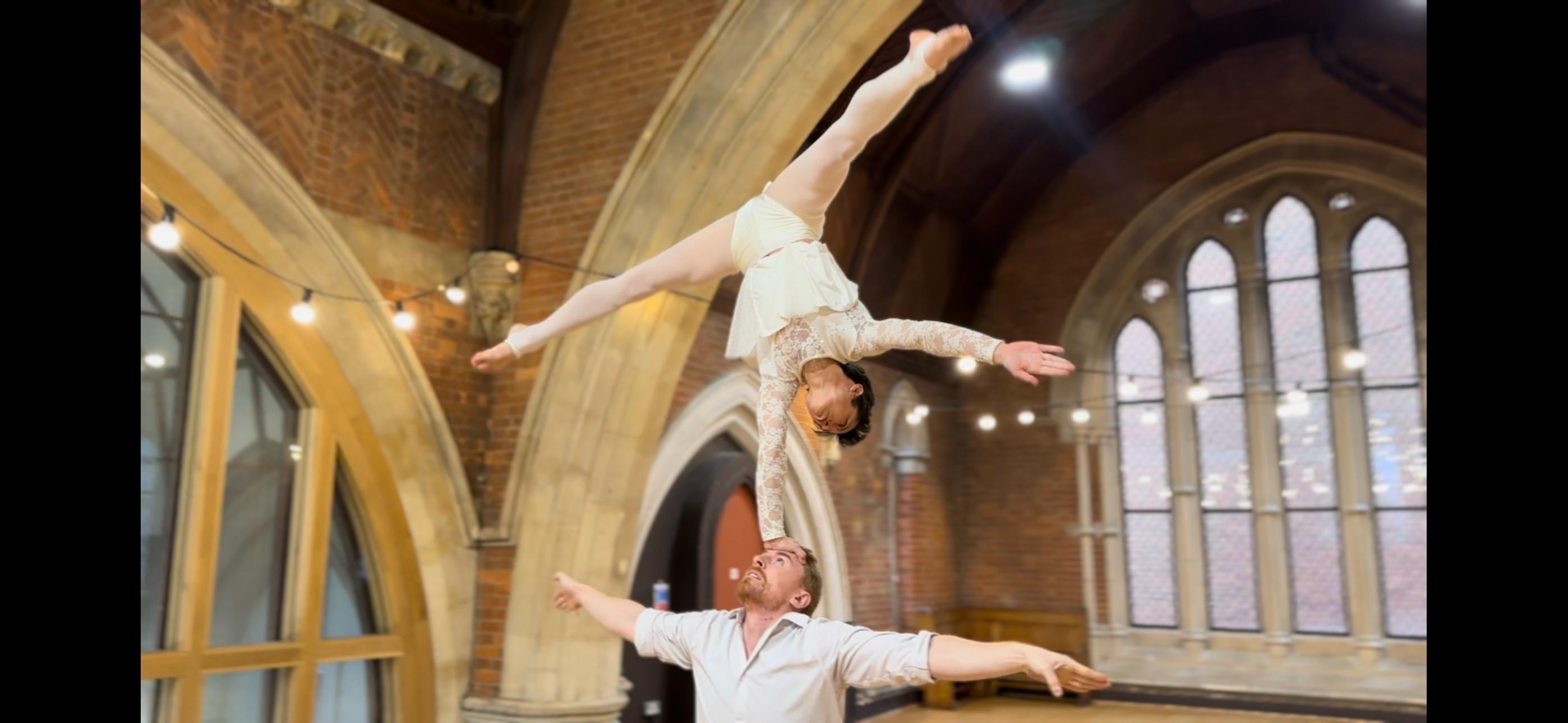
Get ready to flip your world upside down…
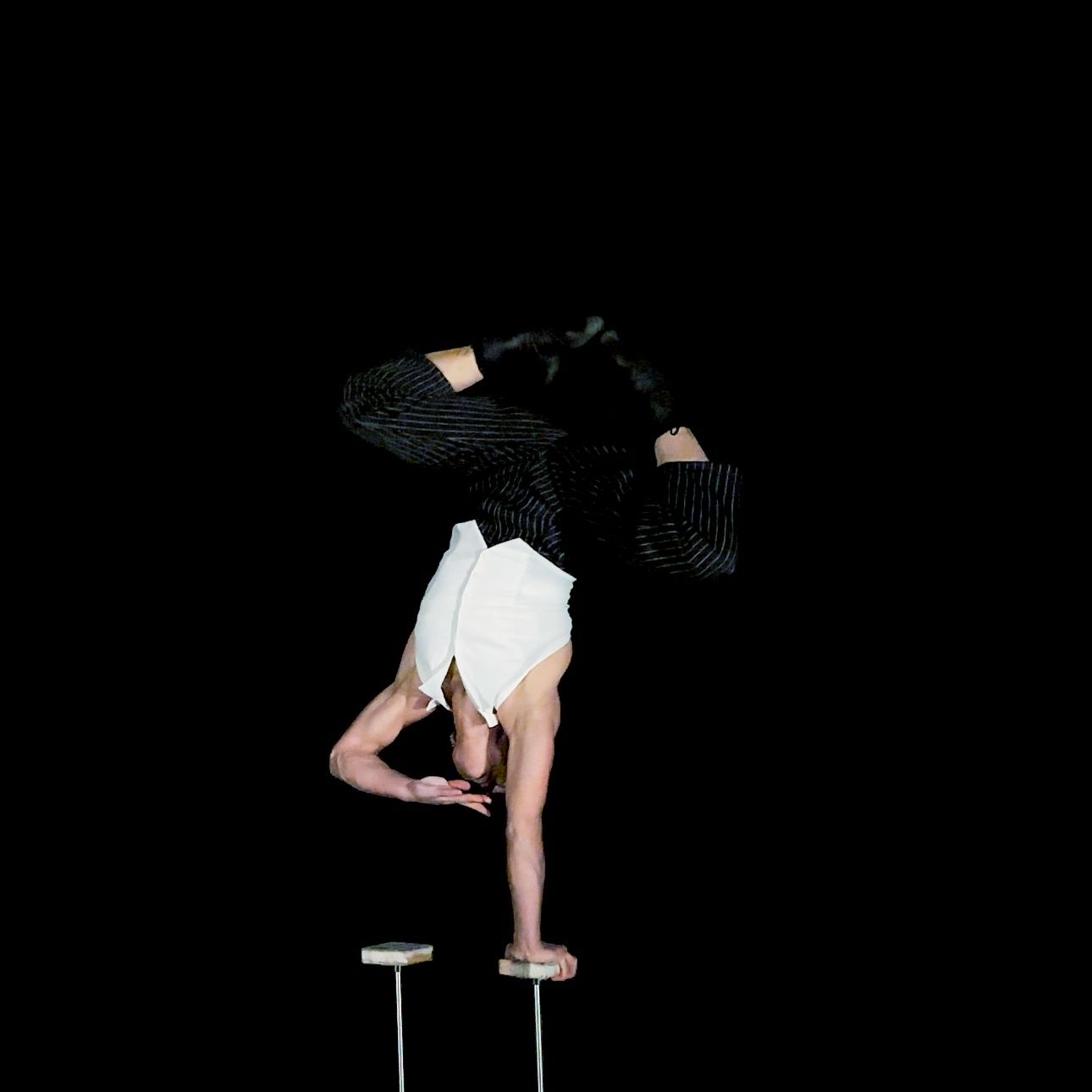
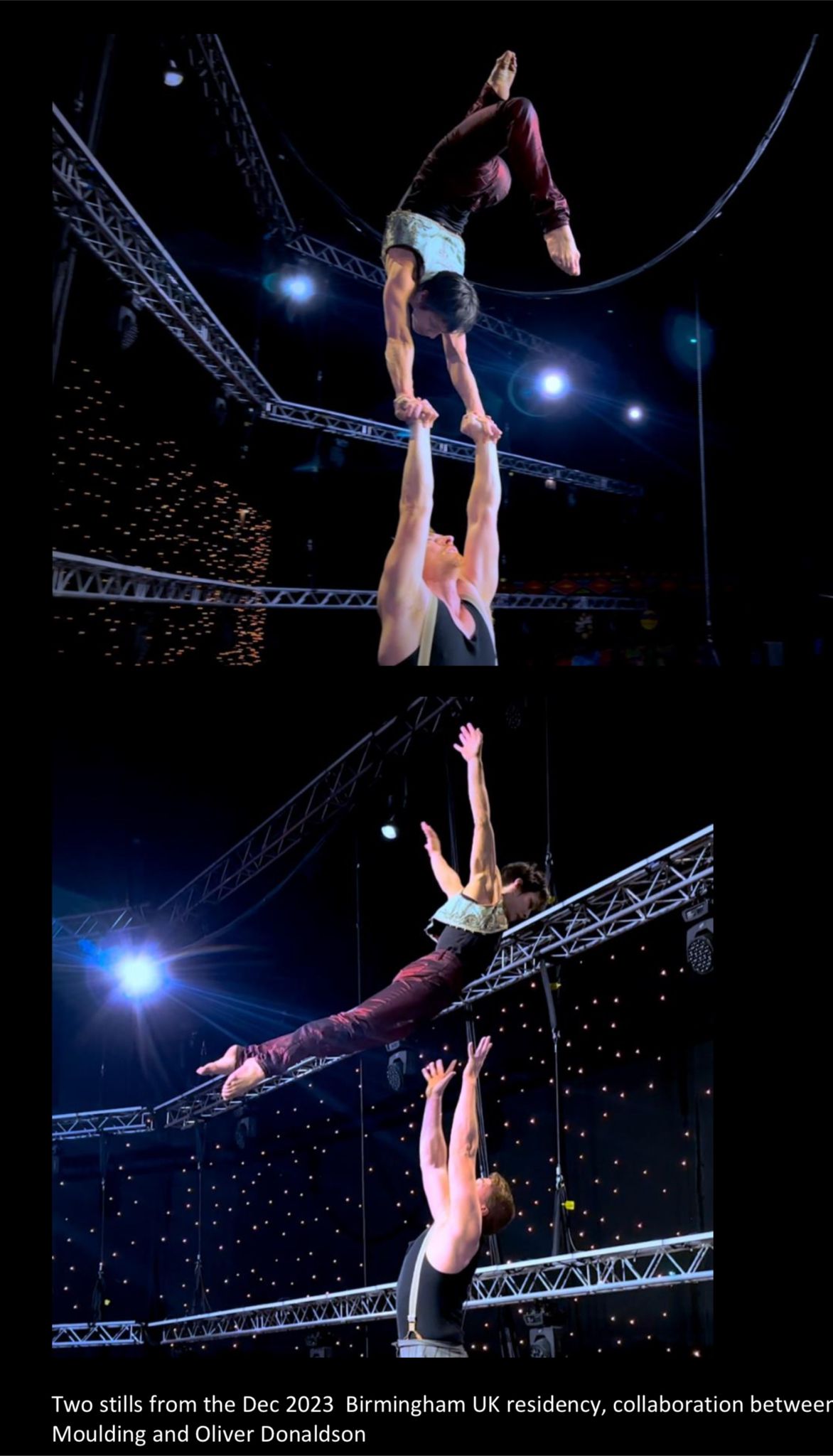
Tamzen Moulding and her hand-to-hand acrobalance partner, Oliver Donaldson, are about to rock your town!
These two are not just any acrobatic duo. They're blazing hot and in demand.
Handstands aficionado Tamzen, a long-term friend of Aerial Edge, has directed her own work for Inverted for eight years and has performed extensively in dance, opera, theatre and circus.
An instructor at the prestigious National Centre for Circus Arts, Tamzen was always a hugely popular trainer when Aerial Edge ran the Edinburgh Aerial and Acrobatic Convention.
And yet she came to circus accidentally!
Tamzen says: “I trained as a dancer and found myself working for a company that also did some circus, so I started to take some aerial classes…and the rest, as they say, is history.
“I looked at my CV one day, and it turned out I was a circus artist.”
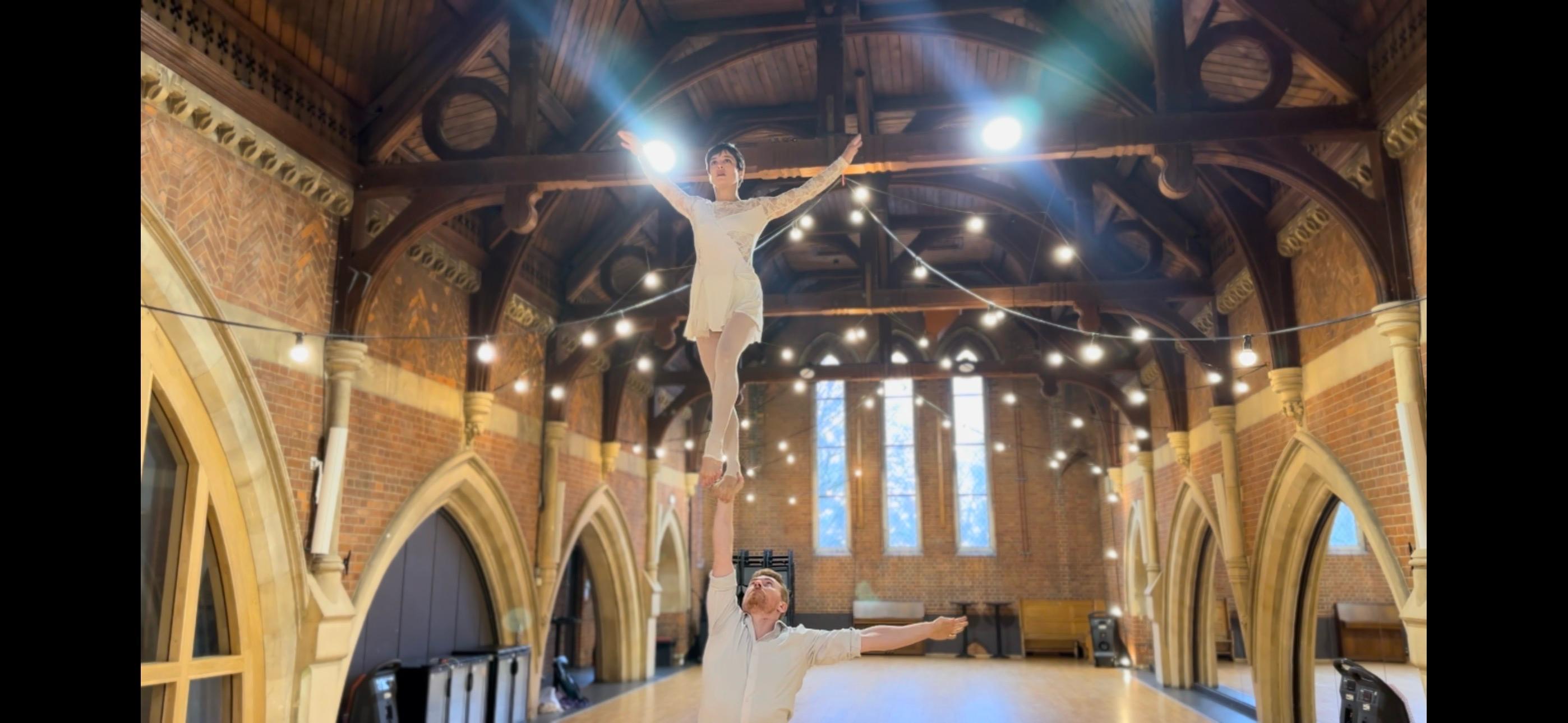
## Fun with rewards
She wants her students to find her classes rewarding and fun, so she’s a perfect fit with the Aerial Edge approach. She also reflects our ethos in understanding that circus is for all.
She says: “Everybody’s body is different, so we should work with our assets to find skills and techniques that work for ourselves.
“That isn't to say that technique isn’t important and that we can't work on our weaknesses, just that we are all built slightly differently, and we shouldn't forget that.
“Whilst learning can be hard work and challenging, I want it to be a positive experience. We should enjoy it. I aim to teach with some lightness while making you work hard and respect good technique.”
As an assistant director/choreographer and consultant, Tamzen has worked in theatre, opera and dance. Her credits include Noye’s Fludde co-production by Stratford East and English National Opera; Illuminations as part of Aldeburgh Music Festival; The Jungle; and Everything I See I Swallow.
As a performer Tamzen has worked for The Royal Court Theatre, ENO, Royal Opera, Cirque Eloize, Upswing, Ockam’s Razor and Batman Live world arena tour.
Oliver’s journey to circus also took a few unexpected turns along the way.
A former member of the Seattle Opera Chorus and a Young Artist with Tacoma Opera, Oliver moved to New York City in 2011 to pursue a Masters in Opera.
He found himself diving into the local circus scene and, just like Tamzen, this new passion took him an entirely different direction.
Oliver has performed in all types of productions all over the world, from theatres and tents to orchestra halls and cruises.
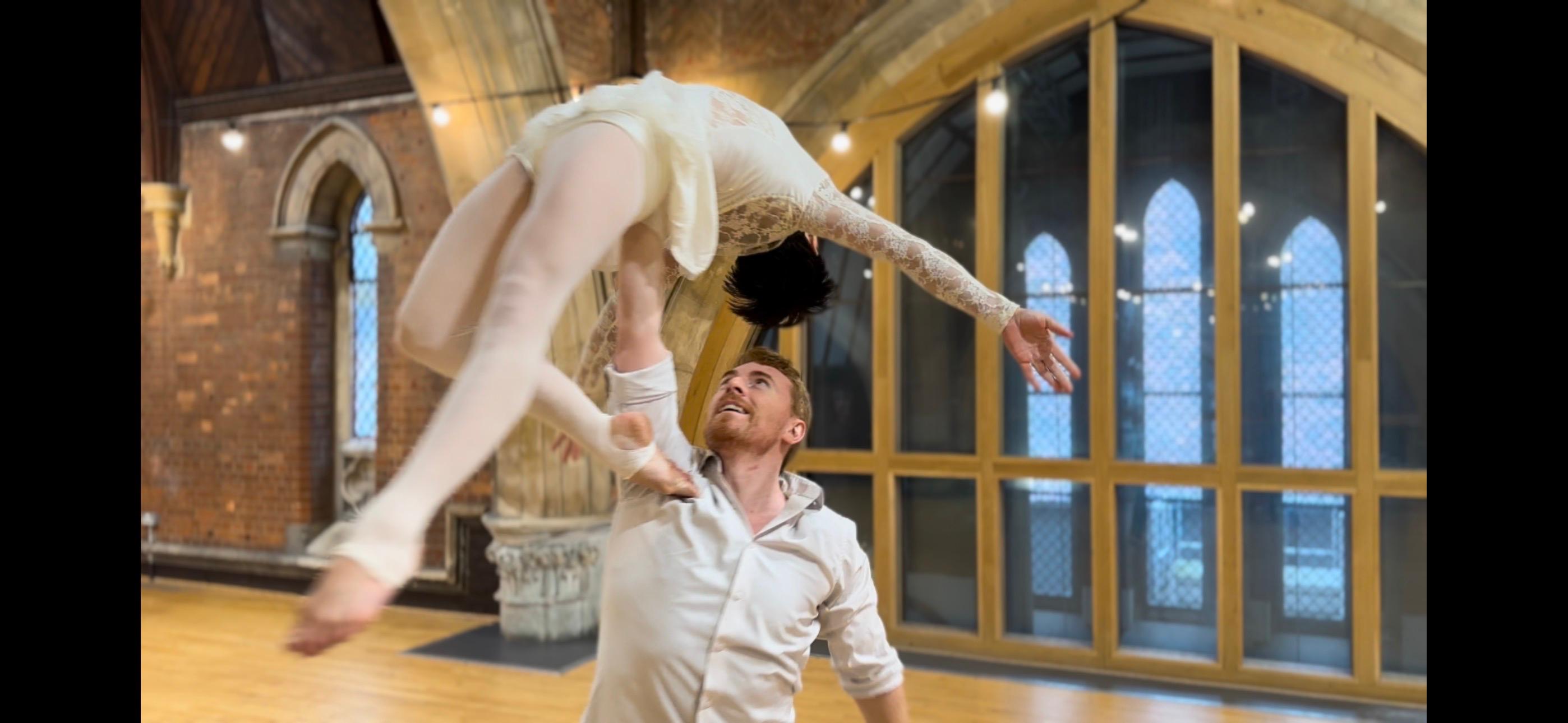
## The addiction of creativity
Tamzen believes that solid conditioning, an understanding of your body and the basics of the discipline are fundamental to learning higher level tricks – and avoiding injury.
And having been a high-level dancer and gymnast since childhood, she should know!
Tamzen competed as part of the British National Gymnastics squad, and trained in contemporary and ballet at the prestigious London Contemporary Dance School.
More recently, she’s been working with hand-to-hand performance partner Oliver, who will co-teach the workshop.
She says: “Circus and creativity are addictive for me, even in dance school I ended up inverted. I can't stay away too long.”
Circus pros will get enormous value from learning about their hand-to-hand techniques in the workshop, and from Tamzen’s Advanced Handstands session.
And the acrobalance enthusiasts at Aerial Edge can get the benefit of their expertise too – the workshop has been set at open level so everyone can flip their lid!
With almost magical timing, Tamzen is arriving just as our flying trapeze students are making significant progress in cradle – and she just happens to be an expert cradle flyer! It’s a perfect opportunity to create a cradle workshop.
Whether you can already hold a handstand for 30 seconds or you're still working towards it, mark your calendar for the end of April because this is an opportunity you won't want to miss.
## Details about the three workshops
#### Hand-to-hand and acrobalance: Friday 26th April, 7:30pm-9:30pm
This is a dive into the connection between base and flyer, looking and at hand-to-hand and feet-to-hand positioning to achieve a good connection.
Starting with basic drills for both flyer and base, we will look at some group acrobatics as well as partner technique.
Prerequisites:
- Open level
<a href="https://goteamup.com/p/3751555-aerial-edge/e/70641481-group-acrohand-to-hand-workshop/" target="_blank" class="button small">Book Workshop</a>
#### Cradle basics: Saturday 27th April, 10am-1pm
Learning to swing on cradle is different to swinging on the fly bar, as anyone who took the Easter Edge Fly + Cradle path can now tell you. This workshop will cover:
- Flyer and base positioning
- General and specific conditioning for both flyers and bases
- Swinging in long hang technique
- Swinging with the flyer in pike, generated by the base
- Timing for opening out of and pulling into pike swing
Prerequisites:
- A good general overall conditioning
<a href="https://goteamup.com/p/3751555-aerial-edge/e/70641485-flying-trapeze-cradle-workshop/" target="_blank" class="button small">Book Workshop</a>
#### Advanced Handstands: Saturday 27th April, 2pm-4pm
In this workshop we will looking at one-arm handstand progressions, which means we will focus on:
- Shoulder and hand positioning for good alignment
- Changing shapes and dynamics in a handstand
- Balance drills
Prerequisites:
- A solid 30-second hold in straight and straddle
- Experience in changing shapes whilst balancing
<a href="https://goteamup.com/p/3751555-aerial-edge/e/70641487-advanced-handstand-workshop/" target="_blank" class="button small">Book Workshop</a>
KayWorkshops summary: Hand-to-Hand and Acrobalance on Friday 26th April – book here Advanced Handstands on Saturday 27th April – book here Cradle Basics on Saturday 27th April – book hereHow to make a breakthrough2024-03-10T00:00:00+00:002024-03-10T00:00:00+00:00http://localhost:4000/events/2024/03/10/easter-edgeChange is inevitable, progress is not. And we all want to progress with our circus pursuits, right?
Most people in circus yearn to be better than they are at some aspect of their discipline, regardless of whether you are a beginner, intermediate or pro. And, by and by, with regular practice, it happens sooner or later.
The degree and speed of progress depends on the choices you make. These may include but are by no means limited to:
- How often you train
- Who you train with
- Your internal chatter
- Your approach to target-setting
- Whatever it is that motivates you
Change isn’t the only thing that’s inevitable. Another certainty is that if you charted your progress on a graph, it will never be a lovely, smooth line going steadily upwards.
If you consistently make good choices, there will be a general upward trend, but it will always be a jagged series of peaks and valleys. No one gets better and better at a trick or sequence each time they try it.
However…
Intensive training with clear intentions turbo-boosts your likelihood of success. When your focus stays on something for a meaningful amount of time, day after day, it smooths out that line on your graph.
That’s the premise of The Easter Edge. And, for that matter, our Pro Track Training Programme too.
Not everyone can take four weeks or four months out of their lives to get the benefit of intensive training on our full-time courses, and those courses aren’t suitable for everyone.
But many people are off work over the Easter weekend.
How much better is it to achieve something you yearn for – a dream come true, no less! – than to get to the Tuesday morning and realise you’ve done nothing worthwhile?
B&Q makes a killing at Easter as people spend their hard-earned time off on some DIY project that could actually be done on any other weekend. Spring cleaning is over-rated and outdated.
Progress is always a mixture of those fabulous, levitational moments when you feel like you hit it just right, then frustration when you can’t do it as well as that for the next seven attempts. Or nine, or more.
But you can reduce the number of wipe-outs and increase the sense of achievement when you crunch those attempts into a short space of time, then add the motivation of deadlines, the encouragement of classmates and the support of instructors.
Progress is inevitable at The Easter Edge. Change is also part of the package!
Over the four days, you’ll pick one discipline for each of the four workshops per day, and that will be your schedule for the weekend. There’s bound to be one of them that you haven’t done in depth before.
If you’re a seasoned circus artist, you’ll probably be used to goal-setting in one format or another, and The Easter Edge will be a great vehicle for you to make your breakthroughs.
If you’re nearer the start of your circus journey, this can give you strong foundations, and you can bring some things that feel out of reach into your reality.
[Book Easter Edge Festival Here](https://goteamup.com/p/3751555-aerial-edge/memberships/194625/)
Click [here](https://aerialedge.co.uk/portfolio/intensive-training/) for more information about Pro Track Training Programme.
## Why this way is so much more satisfying
The Easter Edge is a new concept in the circus scene – a progress-driven full weekend of training in specific arts.
It’s the evolution from the Edinburgh Aerial and Acrobatic Convention (EAAC) which was organised by Aerial Edge for more than a decade.
Instead of a crazy, random selection of taster sessions every day, you will curate your own schedule, choosing four disciplines to work on. You’ll do a 90-minute workshop on each of them every day, and the pathways are designed to gain appreciable progress over the four days.
This could be much more satisfying especially for more advanced acrobats and aerialists, and it allows you to get a solid foundation in an art or two that’s new to you.
Everyone moves together in a cohort so even if you’re at a different level to your classmates, you’ll see each other’s progress and encourage it.
Some workshops are more suited to intermediate or advanced level, but that won’t mean there’s no space for beginners. Few people will have extensive experience in every one of the four disciplines they’re working on over the weekend. Most people will be trying something for the first time.
So join us for a weekend of adventure, laughs and sense of achievement.
### Straps
with Edd Muir
This Easter Edge path will focus on dynamic areas of straps. It’s ideal for people looking to advance their switches and flares to get their roll-ups.
It’s a great opportunity to practice tricks using a pulley system with a quality spotter to guide you through more advanced sequences – for instance, flare to high switch then meathook into low switch.
There are a few moves in straps which are the holy grail – switches, flares, roll ups and dislocations. You’re either trying to resist the movement and stay still in static pose or you are generating movement, and it’s the generation of movement that people struggle with most.
That’s because you need the right techniques – even if you’re strong as an ox, you won’t get there without good technique. These four workshops can embed the technique you need to master to move you forward.
For example, there’s a moment of execution from flare to switch and you can’t mistime it.
And when you do a switch, the final position is side planche. Finding and holding that position will be a big part of what you need to learn.
We’ll be using the pulley system to suspend you off the ground, so your movements are not limited by the floor. This is great to generate spin and lift you so you don’t worry about bottoming out the trick. We don’t generally get to do this in an ordinary straps class.
Suggested prerequisites: be able to do a pull-up and straddle over from hanging position. Straps is like rope and silks in that you get the most out of it when you gain a certain level of strength, but it’s also great if you know nothing about it because it’s very effective for conditioning. You may want to bring your own wrist wraps.
### Chinese Pole
with Edd Muir
This path is suitable for you if:
• You’re a seasoned pole person who wants to develop ballistic style
• You’re a shiny pole person who wants to transfer skills
• You’re a beginner who wants to learn a cool trick or two
There are a few exciting moves that you can execute without having had any previous experience – sliding down the pole head first is one of them. That alone is your Instagram moment.
Beyond that, the learning curve is a brick wall – you need the foundational skill of the climbs to be able to execute the tricks.
Sometimes in classes people lose heart when the they want to hit the tricks and they haven’t got the patience to learn the climbs. The great news is that you can definitely master the climbs over these four consecutive workshops, then you’ll have the solid foundation to move on to the thrills.
Edd was taught with the old Chinese style, which is ballistic – sudden bursts of movement, going from static to somersault to catch. For example, fish to flag/Superman pose, beat out and use that momentum to swing out to human flag.
A lot of shiny pole people want to transition to Chinese. Because it’s covered in rubber, you don’t slide so it allows you to be more static, to let the pole give you purchase to do more ballistic moves. You’re not manoeuvring with the slide.
The challenge is that to be able to hold a move, you need to hold your own weight with body tension, whereas on shiny pole you can wrap.
Once you’ve got that, you can more cool ballistic somersaults, catch and release tricks etc. It looks more impressive, definitely more acrobatic.
In this path, you’ll work on the human flag. Everyone wants to get that, and it’s totally achievable.
Fongi is another popular move that will be in the path – a shoulder mount and swing and twist back to the start, and shoulder to fish.
Prerequisities: Soft rubber-soled flat shoes like Feiyue or old-fashioned plimsolls (not trainers), and layers on the body such as leggings and jeans, Long-sleeve T-shirt and sweatshirt.
### Dynamic Rope
with Freya Pellie
Rather than focusing on static poses, this class series will equip you with new dynamic ways of moving in the air – giving you new choreographic options, snappier entrances to familiar wraps, and moments of weightlessness that will make new transitions possible.
Over the intensive you’ll build a solid foundation in dynamic rope, covering fundamentals such as front-back beats, straddle beats, bell beats, flares, and hula to S-wrap.
We’ll likely also spend some time on S-wrap roll-downs to give your hands a break!
If oyu have some prior knowledge of beats, pathway variations and beat combos will be offered and we’ll look at some sequencing.
Suggested pre-requisites: 10-second dead hang, be able to invert in the air (i.e., without using the floor).
### Acrobatics
with Sam McFarlane
Over the course of the four sessions, you will experience a broad range of ground-based acrobatic activities, such as handstands, tumbling, acrobalance and partner acro.
You’ll be working on movement inspired from dance, gymnastics and martial arts.
You will explore a range of transitions and variations which are useful for combining movements.
We will be making full use of the tumble track along with other apparatus as we use these skills to create fun sequences and to interact with our fellow students either in partner acrobatics or group synchronicity.
### Trampoline
with Sam McFarlane
This path has its ups and downs! You’ll spring to life after learning some simple and safe basics, and work up to wall running and inversion techniques.
Past experience as a bouncer not necessary, and we can jump to more difficult moves according to your skill set.
As well as being super fun and an art in its own right, trampoline is really helpful in developing the proprioception necessary for aerial and ground-based acrobatic skills, which is why it’s always in our full-time training courses.
When you practice moving through the air frequently, you start to recognise where you are regardless of what stage you’re at in the movement, no matter which way is up.
When this no longer requires conscious effort, your brain can work on the specifics of the trick you’re trying to nail.
### Silks and Rope
with Nea Kunnari and Bara Dankova
This path is suitable for all levels and experiences, and would work well alongside the dynamic rope pathway.
You will cover the basic locks and shapes like footlock, hiplock or catchers, to ensure everyone has solid foundational skills and refine them if you have experience.
Perhaps you will be experimenting with finding new way in or out, or varying the shapes that you move through while you reach a lock.
Then the focus shifts to discovering your individual ways to make them more interesting, and to placing them into your own sequences.
Some creative doubles work will be Interspersed throughout the first three days, based on where you want to go with it, and on Monday there will be time for more personal explorations.
In martial arts traditions, it’s considered vital to revisit the most basic patterns of movements regularly, because:
• There’s always some refinement that you can make which helps you grow in different directions.
• You have developed as an individual so you are approaching something that’s no longer a conscious activity from a different perspective, which can mean you are able to take something completely fresh away.
• Revisiting a familiar and foundational form with a different level of experience can leads to a breakthrough in a more advanced pattern.
This pathway will give you the opportunity to reap these rewards as well as to gain creative expansion on your current skillset. If you’re new to these two similar yet very different arts, you’ll gain a solid foundation and capture some great Insta moves.
### Aerial Hoop
with Freya Pellie
Rather than focusing on static poses, this path will equip you with new dynamic ways of moving in the air, giving you new choreographic options, snappier entrances to familiar moves, and moments of weightlessness that will make new transitions possible.
There will be a focus on spins and swings, beats and flares.
Over the intensive, you’ll build a solid foundation for beginning your dynamic journey, covering fundamentals such as front-back beats, bell beats, and flare pathways, as well as learning how to generate faster starting spins and carry that force with you into the air. We’ll also look at elbow and hocks beats, and pathways using these.
Suggested pre-requisites: 10-second dead hang, be able to invert in the air (i.e., without using the floor).
### Doubles Trapeze
with Mark Gibson
If you want a quick route to developing your own doubles trapeze act, this would be a great path for you.
This series of workshops will have you developing a series of moves into a performable duo piece.
You’ll start with static basics and move swiftly on to flow sequences.
You’ll will cover some dynamic catch-and-release tricks with the help of safety lines to add a thrill factor.
And we’ll take people as far as they can go safely in the four days.
Book in with a partner or let us know if you are looking for one.
Suggested prerequisites: Basic aerial skills. Bases will need to be able to get to catchers and flyers will need to be able to invert in the ropes.
### Dance Trapeze and Big-Ass Static Trapeze Tricks
with Mark Gibson & Vee Smith
Strap on your gaiters! It’s time to pull off some of the more thrilling and daring moves on static and dance trapeze
Over this series of workshops, you’ll push past your current limits as you move between Vee’s expertise in dance trapeze and Mark’s big-ass tricks on static.
On static, you can play with catch-and-release tricks such as:
• Knee lean-out, drop to ankles
• The apple
• Hope and Pray
• Big drops to ankles
• Dismounts
• Elbow rolls
• Back balance rolls
• Belly spins
Each day we will also build up your use of dynamic beats to generate the forces necessary for big-ass tricks.
Dance trapeze is different not just because it's rigged from a single point which allows it to spin on the spot – although that alone can transform a simple sequence into something more impressive, especially at low height.
It's not even that you can play with a much bigger range of movement by swinging on it, and making it swoop round in large circles, spinning as you go.
And it's not that it opens more possibilities for integrating movements on and with the trapeze while you're on the floor.
It's about how you can use all of the above to dance with the trapeze. The movement of the trapeze itself lends a sense of flow that makes your sequence seem more graceful, or dramatic. Whatever effect you seek to give, the dance trapeze somehow emphasises it.
Prerequisites: ability to invert and do one pull up, good hocks hang and a sense of adventure.
### Flying Trapeze
with Gabriel Stella and Mete Mercan
What you learn in this series of workshops will depend on your experience and skill level when you arrive. This is an open level pathway so some people may be there for the first time, while others may be throwing big tricks to catch.
Some examples of outcomes from these sessions would be:
• If you’re an experienced flyer, you will be using this series of workshops to come out with a tangible result, such as taking a trick out of lines, nailing the next big trick on your list, or drilling a return to the fly bar and platform with your favourite trick.
• You could use this pathway to learn to swing confidently out of lines so that you can join the intermediate classes and workshops in the Aerial Edge monthly schedule (you would also be working on tricks and returns during these sessions).
• For any new flyer, taking a trick to catch would be a good result in one class, while some people may take longer. Over the course of four days, you could expect to throw more than one trick to catch.
Suggested prerequisites: four consecutive workshops can be hard on your hands so we’d suggest investing in some tape, and/or gymnastic hand guards. Even if you don’t use them all the time, they will offer some protection.
### Flying Trapeze and Cradle
with Gabriel Stella, Mark Gibson & Mete Mercan
Tricks and swings on the cradle catcher are entirely different to the ones you do on the fly bar, so this series of workshops is invaluable for taking your flying trapeze repertoire to a completely different level.
Cradle is also a circus discipline in its own right and we’re keen to get enough people into it that we can build dedicated sessions into the Aerial Edge schedule. In these workshops you can train as a flyer or base or both.
This workshop is open to all levels – we will start from wherever you are and make progress from there.
In the cradle section, you will begin with swings on the catcher – like your flying trapeze swings, this alone can be a life’s work to perfect!
It takes consistent repetition to move the different swings technique out of your conscious mind and into your muscle memory and this series of workshops is an ideal opportunity to get this embedded.
This will improve your ability to return to the bar and platform as well as opening a whole new world of tricks with the catcher, such as somersaults, cocktail bar and pirouettes.
If you’re ready and up for it, you can train tricks which start from the top of the cradle, such as pike off.
During the sessions on this pathway, you also work on your fly tricks and see the gains when you return to bar from the catcher.
### Flow arts
with Yara Fares
In this path you will learn to work with two very different flow props, hula hoop and rope dart.
Most people are familiar with hula hoops from childhood but this series of workshops will take it far beyond the ability to circle it around your waist.
Rope dart is a martial arts weapon. It’s similar to poi but it’s only one weight and the cord can be lengthened during the flow for dramatic effects and different tricks.
With hula hoop, we will be focusing on learning ways to find our flow, and with rope dart it’s more about tricks and target shot aiming.
Flow arts blend dance, martial arts and object manipulation into a mindful activity that results in flow, a meditative state.
The flow state has been well documented, with evidence that it enhances creativity while relieving stress and anxiety.
In hula hooping you will learn:
• A range of tricks, depending on your level and how you move with them
• Transitions
• Speed play
If you’re familiar with flow arts and already know how to get into flow, we can focus on learning more and bigger tricks and variations such as floor work, foot hooping variations, coinflips and advanced chest rolls.
In rope dart you will learn:
• Tricks such as neck spin, sunrise, dragon wrap
• Combos
• Target shot aiming, different kind of shots
### Teeterboard
with Mark Gibson
These sessions will cover two types of teeterboard – Korean and Chinese.
In Korean plank, you learn how to work with a partner, one of you on each end of the teeterboard, pushing down and being propelled up.
This is to develop good technique for building first of all rhythm, which then leads to height. When you’re able to push each other to a good height, you can take turns at throwing tricks.
These can either land on your own side of the teeterboard, or you can flip to the other side, or other people can step into your place.
You’ll also learn Chinese teeterboard, which is where you get the thrill of the tricks without needing to develop the rhythm because two or more people will land on one end of the teeterboard, propelling you into the air for big tricks in safety lines.
Many people find this a great way to develop back somersault technique even if it their first time with little experience.
It will be possible to move on to even bigger tricks during the course of the weekend.
Prerequisites: No experience needed, but you will want some supportive trainers for this class.
Pricing:
- Early bird offer: £299 until Saturday 9th March
- Individual path pricing: £90/ 4 class path
[Book your festival pass here](https://goteamup.com/p/3751555-aerial-edge/memberships/194625/)
#### Booking Process
**Step 1 - [Buy your festival pass](https://goteamup.com/p/3751555-aerial-edge/memberships/194625/)** £299
**Step 2 - Select your 4 pathways for the weekend**
- Go to the [Aerial Edge Course Booking page](https://goteamup.com/p/3751555-aerial-edge/courses/)
and select 1 pathway for each timeslot that you will follow for the 4 days, or click the links below
> Timeslot 1 Options - 10:00-11:30
> - [Flying trapeze open level](https://goteamup.com/p/3751555-aerial-edge/courses/99547/)
> - [Flow arts](https://goteamup.com/p/3751555-aerial-edge/courses/99548/)
> - [Static & Dance Trapeze](https://goteamup.com/p/3751555-aerial-edge/courses/99549/)
>
> Timeslot 2 Options - 11:45-13:15
> - [Flying trapeze & Cradle](https://goteamup.com/p/3751555-aerial-edge/courses/99550/)
> - [Acrobatics](https://goteamup.com/p/3751555-aerial-edge/courses/99551/)
> - [Aerial hoop](https://goteamup.com/p/3751555-aerial-edge/courses/99552/)
>
Timeslot 3 Options - 14:00-15:30
- [Dynamic rope](https://goteamup.com/p/3751555-aerial-edge/courses/99553/)
- [Straps](https://goteamup.com/p/3751555-aerial-edge/courses/99554/)
- [Teeterboard](https://goteamup.com/p/3751555-aerial-edge/courses/99555/)
>
Timeslot 4 Options - 15:45-17:15
- [Trampoline](https://goteamup.com/p/3751555-aerial-edge/courses/99556/)
- [Doubles trapeze](https://goteamup.com/p/3751555-aerial-edge/courses/99557/)
- [Silks/Rope Open level](https://goteamup.com/p/3751555-aerial-edge/courses/99558/)
- [Chinese Pole](https://goteamup.com/p/3751555-aerial-edge/courses/99559/)
**Step 3 - Train Circus!**KayChange is inevitable, progress is not. And we all want to progress with our circus pursuits, right?Brazilliant chance to train in the sun2023-07-21T00:00:00+01:002023-07-21T00:00:00+01:00http://localhost:4000/programmes/2023/07/21/brazilliant-chance-to-trainMuch as we adore our warehouse venue in Glasgow, heck, it would be mad to miss the opportunity to enjoy circus training in sunnier spots in the world. Now’s your chance to train your favourite arts in Brazil – including flying trapeze right next to a gorgeous beach.
Aerial Edge flying trapeze instructor Gabriel Stella and fly pole teacher Helen Anderson are organising the two-week adventure at Circocan, the school where they met and mastered their arts. If you’re up for it, book some annual leave for the first two weeks in November!
One of the great things about circus training is having fun with a diverse bunch of characters from the aerial and acrobatic community all over the world, who are all at very different levels of experience from beginner to master.
These folks tend to travel – we’ve lost count of the number of nationalities and languages at Aerial Edge. We make that two-way street, by collaborating with other circus people across the globe to give you the opportunity to travel to meet new people and see new places too.
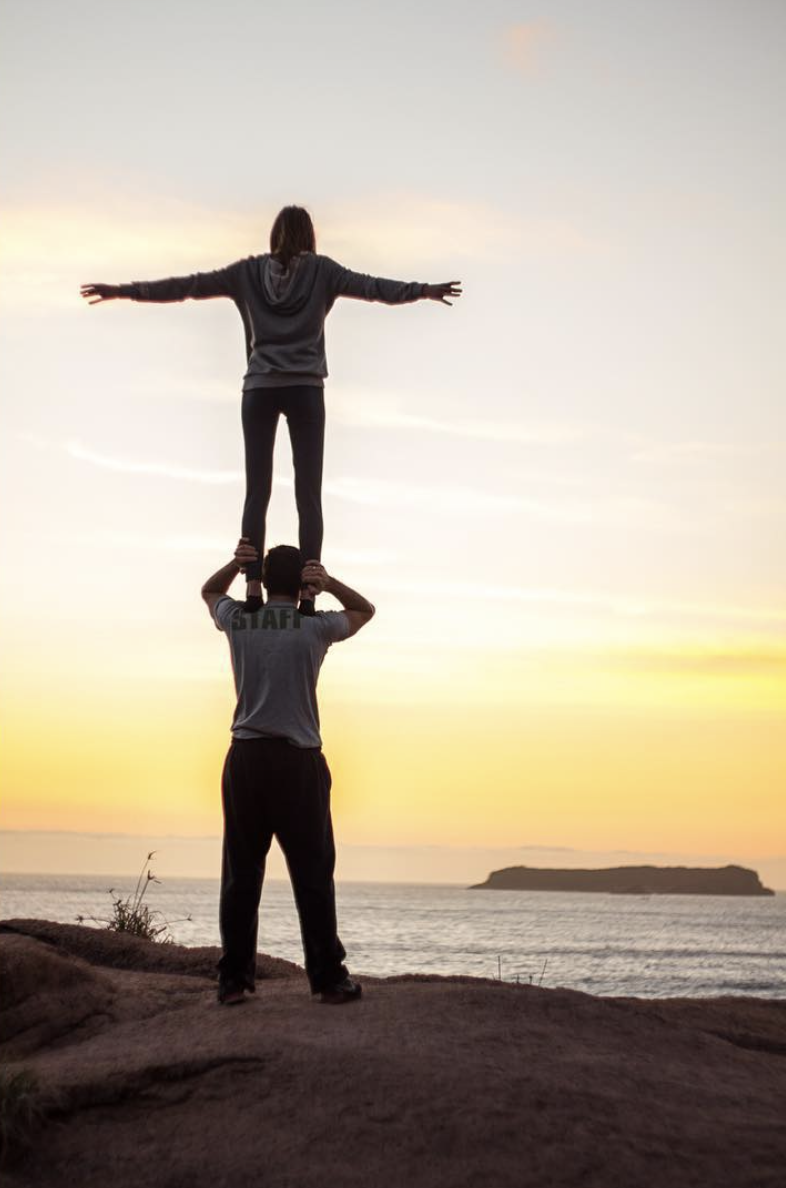
Gabe says: "Circocan is my second family. I can’t wait to take my own students to experience how incredible circus is in Brazil, and that’s the main reason I am doing the retreat.
### ‘A one-of-a-kind experience’

"It’s incredible being there with nothing to worry about at all, meeting new people and just living circus. You just enjoy training in a warm environment free of judgment and competition.”
And Helen says: “I was still at a hobby level of circus training when I went to Brazil to do the six-month foundation course at Circocan in 2017. The first five days were the camp that we’re now taking Aerial Edge students to.

“It was perfect for meeting people and integrating, and I was in this secluded paradise land, surrounded by circus. That was really cool.
“It’s super fun…and the food is amazing! It’s a one-of-a-kind experience, it bonds everyone, you’re all in it together. People were so easy to get along with, I made a lot of amazing friends there and I’m still friends with them.”
### The camp of dreams
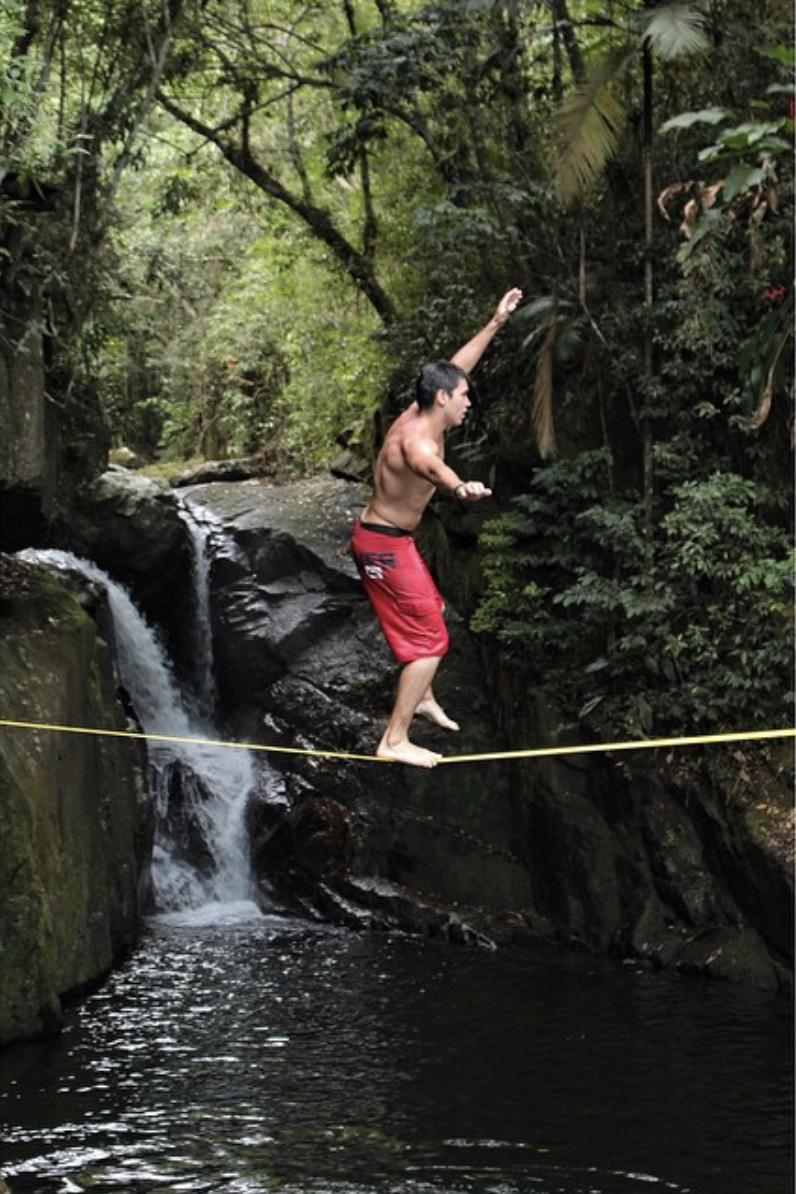
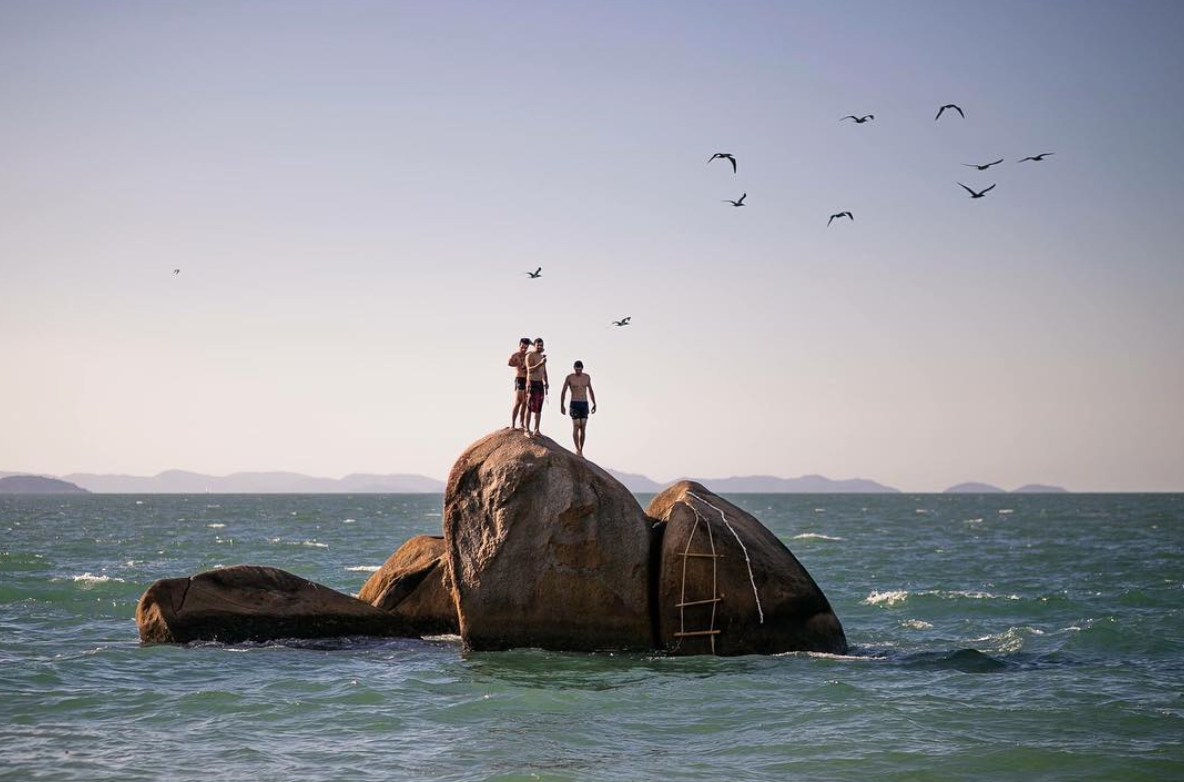
The five-day camp is at what’s loosely described as a ranch – but think less of cowboys and horses and more of all the fabulous circus equipment you could dream of, surrounded by lush forest.
The camp gives you a foundation in strength with flexibility and whatever arts you want to pursue – including flying trapeze on the full-size grand volant flying trapeze rig.

In the evenings there’s chill time, movie nights, games nights and enjoying the jacuzzi and natural outdoor swimming pool (you’ll see people using the teeterboard instead of a diving board).
After that, Gabe and Helen are taking you to the island of Florianopolis for a week of flying trapeze on the big rig in the hotel’s gardens.

### It’s easier than you think to go big
If you’re nervous about making the transition from our petit volant rig to the grand, don’t worry!
Helen says: “I had never done grand volant before I went there. It’s easier than you think it’s going to be. If you’ve been training on the Aerial Edge rig, you already have the foundations, so you’ll just have more time to do the moves.
“And it’s outside in the sun with the sea just over the road, who doesn’t love that?
“The island is amazing, I loved living there, and the climate is lovely. I’m so excited to back there.
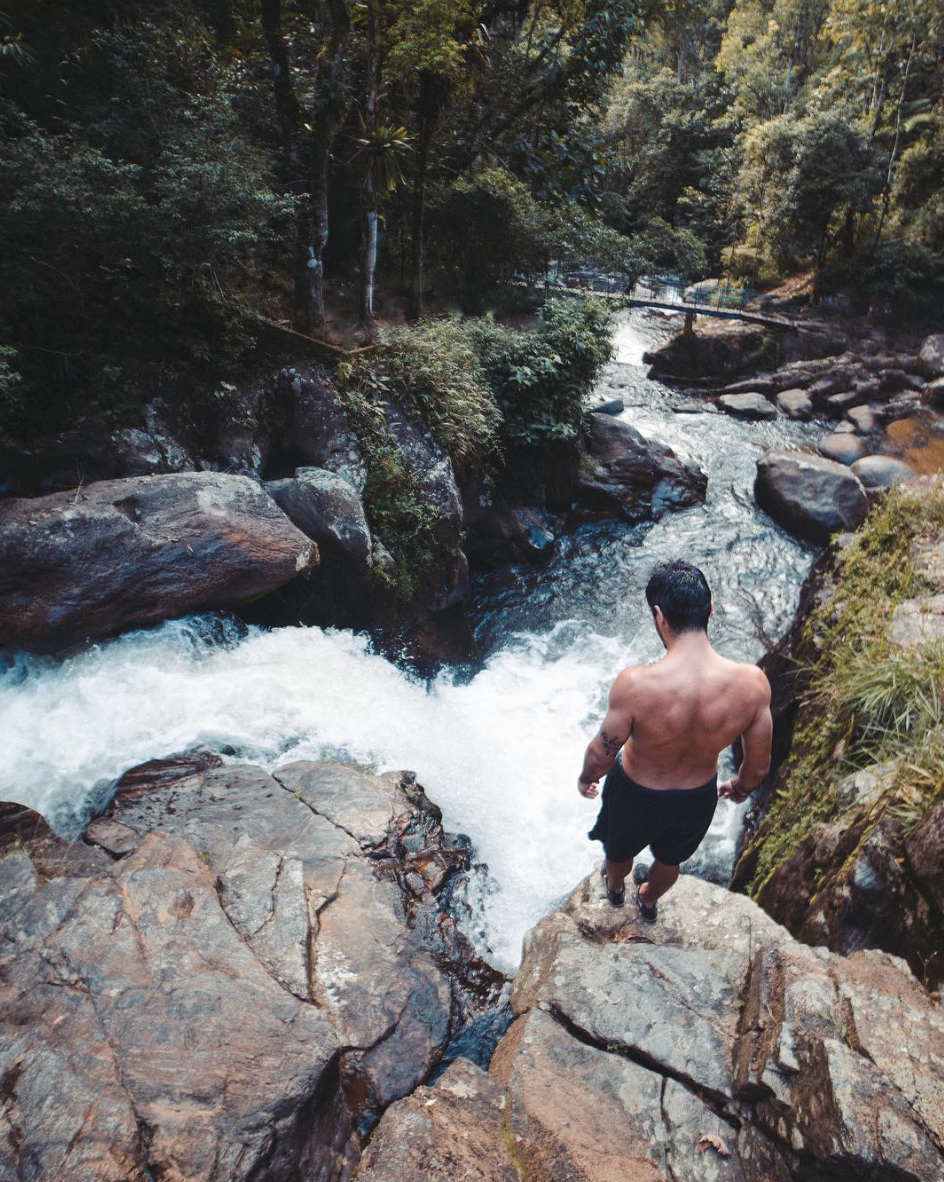
“You’re surrounded by gorgeous beaches, waterfalls, hikes, and it’s safe. It’s a little bit of a party island, and there are great restaurants and trendy bars around. November is the right month for seeing whales and dolphins.”
As well as teaching the fly classes, Gabe and Helen will act as your guides if you want to explore.
If you want to do more circus every day instead of exploring, Circocan school is based at the Florianopolis location (they rent the ranch camp as an annual event).
Gabe says: "I was thinking of three hours of fly per day, but we can adapt or have rest days so that people's hands survive the whole thing!
"And what about the rest of the day? We are free to do whatever we want and the options are endless. We could hike to deserted beaches, or go canoeing, or go swimming under a waterfall that's like paradise, learn to surf, or just enjoy a drink and a nice meal with your feet on the sand."

### How do you get on board?
Email Gabriel@aerialedge.co.uk or chat to him or Helen when you're in the space – but be quick! All the booking will be done on Friday 28th July to get good prices and because places are so limited.
Gabe has set up a WhatsApp group for people who are interested, to keep up to date with developments.
For further info, see this video about this year’s 5-day camp and this video of a previous one. This reel shows the grand volant rig at Florianopolis. The brochure below is for this year’s 5-day ranch camp.
[Circocan Brochure](/assets/images/posts/PDF-CAMP-NOV2023_red.pdf)KayMuch as we adore our warehouse venue in Glasgow, heck, it would be mad to miss the opportunity to enjoy circus training in sunnier spots in the world. Now’s your chance to train your favourite arts in Brazil – including flying trapeze right next to a gorgeous beach.The reluctant performer from Cirque du Soleil2023-06-15T00:00:00+01:002023-06-15T00:00:00+01:00http://localhost:4000/programmes/2023/06/15/reluctant-performerHard to believe that someone who’s just spent three years in a Cirque du Soleil spectacular show in Las Vegas never fancied being a performer. But that’s Luke Quadrio, our guest acrobatics instructor who is arriving in August.
An introverted child, he found his way to the pinnacle of circus performance from a simple starting point: a garden trampoline and an abundant choice of trees to climb in rural north-eastern Australia, near Brisbane.
Even as a teenager who was coaching trampoline, gymnastics and parkour, he wasn’t for putting himself out there on the stage.
“It was never about the performance for me, I had no interest in competing despite my coach always trying to persuade me. I really just liked doing flips,” recalls Luke.
Don’t we all? But don’t make the mistake of thinking Luke isn’t competitive when it comes to his other passion: board games!
“Dune Imperium is my go-to game,” says Luke, “but honestly, anything strategy-based.”
When circus came a-calling, Luke’s life took a totally different trajectory.
“I was studying business at Uni because I naively thought that's what I needed to do to get a job,” he says. “I found circus through some parkour and gymnastics friends that I trained with, and loved the creative nature of it.
“In the last semester, a mentor of mine mentioned Beijing's circus school to me in passing and I instantly liked the idea.
“I did some research and then mentioned it to some of my students who were looking for tertiary circus education. Myself and three of them decided to move there together to train.”
It was during the three-year programme at Beijing International Art School that Luke decided to specialist in Chinese pole. His creative and compelling use of this apparatus is what led him to become a Cirque du Soleil performer.
Since he finished the programme in China, Luke has followed his devotion for circus arts in his home country and around the world, sharing his extensive experience in a variety of disciplines both as a performer and an instructor.
One of his locations was in Brazil, where he met our flying trapeze instructor Gabriel Stella at Circocan. Through this connection, Aerial Edge is fortunate to be able to invite Luke to be our guest instructor for the full-time four-month Foundation Course which starts in August.
Along the way in his travels, he’s become an accomplished linguist and learned a lot about yoga.
“I speak English, Spanish, Portuguese, Italian, Chinese and I'm learning French at the moment. The romance languages interest me more than any others,” says Luke.
“As an eternal student myself, I believe anyone is capable of learning anything with enough patience and the right attitude.
“I’m eager to join the Aerial Edge family!”
- [Foundation Course](https://aerialedge.co.uk/portfolio/intensive-training/)
- [12 week acrobatics course](https://goteamup.com/p/3751555-aerial-edge/courses/88548/)KayHard to believe that someone who’s just spent three years in a Cirque du Soleil spectacular show in Las Vegas never fancied being a performer. But that’s Luke Quadrio, our guest acrobatics instructor who is arriving in August.Travel & logistics FAQ about Levitate circus arts festival2023-05-12T00:00:00+01:002023-05-12T00:00:00+01:00http://localhost:4000/services/2023/05/12/levitate-faqAre you ready to Levitate? We certainly hope so! We’re stoked about this new collaboration for Aerial Edge and the Middle Eastern summer circus arts convention. You’re invited!
Aerial Edge Founder Mark Gibson will be teaching at the Lebanese festival, along with another of our favourite collaborators, Adilso Machado from Brazil.
Levitate was founded last year by Judy Salloum, guest instructor for our full-time Foundation Course. When her time with us comes to an end in June, she fly to her home country Lebanon to finalise the festival organisation.
#### Where do I fly to?
[Beirut-Rafic Hariri](http://www.beirutairport.gov.lb/index.php) International Airport – there are direct flights from most countries in Europe and the Middle East. Check [Skyscanner](https://www.skyscanner.net/) for flights from where you are.
#### Is there any documentation required?
Just a straightforward single entry tourist visa, which you can get on arrival free of charge.
Your passport must be valid for at least three months from the date of entry to Lebanon (some sources say six months).
If your passport contains an Israeli stamp, you may be refused entry even if you hold a valid Lebanese visa. You may apply for a second passport to avoid this.
British Overseas Citizens, British Protected Persons and people of Palestinian origin need to get a visa before travelling. Guidance may change at short notice so check with the Lebanese embassy before traveling.
#### How do I get the local currency?
Forget it! Take US Dollars instead. The Lebanese economy is in crisis so the exchange rate fluctuates all the time. Dollars are widely accepted and more reliable. Don’t use credit cards, stick to cash. You can’t pull cash out of ATMs, so get your Dollars before you travel.
#### Will there be internet?
Check your mobile phone roaming contract. You can buy a local SIM card at the airport or mobile phone shops in Beirut and set yourself up with WhatsApp etc. WhatsApp calling works in Lebanon.
#### How do I get from the airport to the festival venue?
You can get an Uber! Levitate organisers can also arrange a carpool so check with them who else might be arriving around the same time as you.
You’ll have to pay cash rather than through the Uber app. Careem is another app that works the same way, or you can use one of the taxi services below. The price will vary from 20-30USD.
Most drivers speak English so you can arrange a pick-up before you travel via WhatsApp, and there’s wifi in the airport so you can connect with them when you land.
As with many airports across the world, there are taxis loitering outside, but they are best avoided.
Alternatives to Uber and Careem are here:
- Allo Taxi +961 1 517 070
- Geryes Taxi +961 1 333 666
- Elegance Taxi +961 9 333 332
- Snow Taxi +961 3 583 068
- Charlie Taxi +961 1 285 710
- Relax Taxi +961 3 952 293
#### What is included in the price of the festival pass?
Tuition, accommodation, bottled water, three meals a day…and unlimited joy. Sunshine! Beautiful scenery, and a starry sky. And, of course, new friendships and creative exchanges.
All passes give you access to the gala night showcase and the opportunity to perform in the open stage night. If you’re coming for the 5-day or 4-day intensive, you can also appear in the ensemble performance if you want.
Workshops include aerial, acrobatics, acrobalance, dance, prop manipulation, juggling, unicycle, handstands, clowning, circus conditioning, flexibility, yoga, aerial movement, act creation, rigging and safety.
You can find more information about the workshops and teachers on [Instagram](https://www.instagram.com/levitate.leb/) and [Facebook](https://www.facebook.com/LevitateCircus).
Snacks will be available to buy at the festival site.
#### I have food allergies/intolerances, can you cater for that?
Of course. When you’ve booked your ticket, you will be sent a form about dietary requirements.
#### What’s the accommodation like?
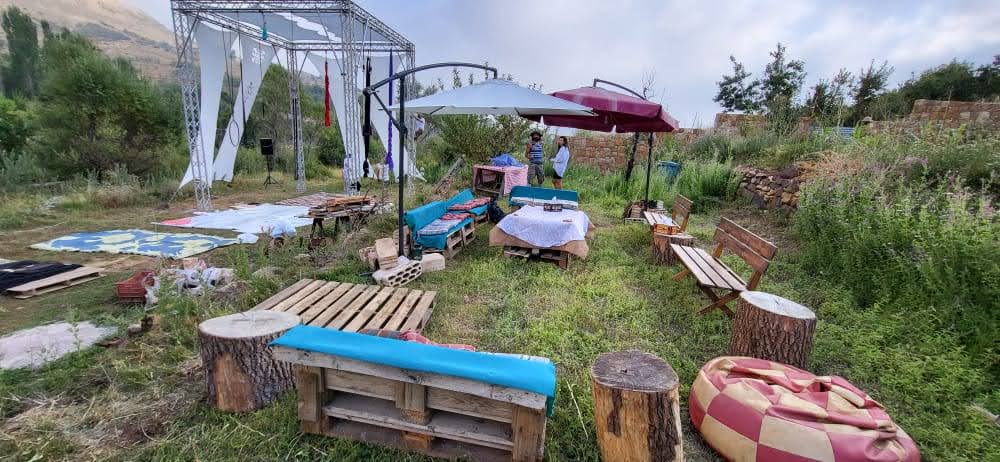
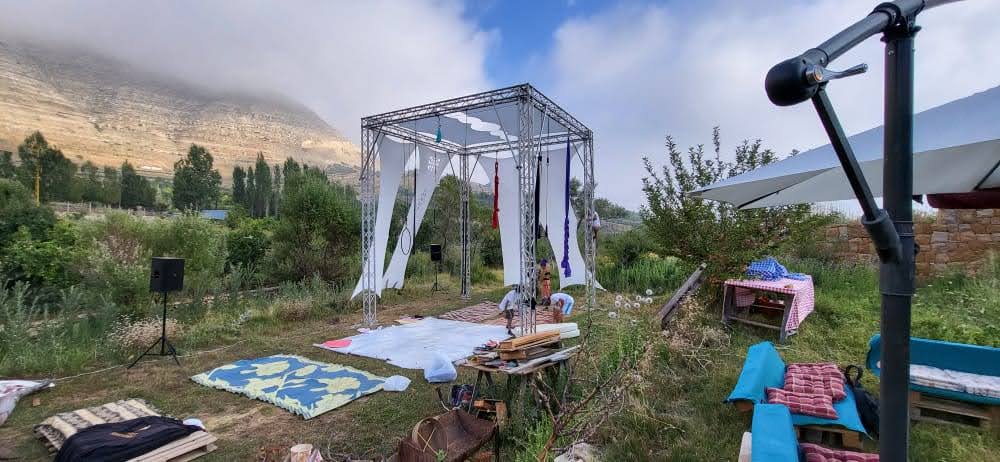
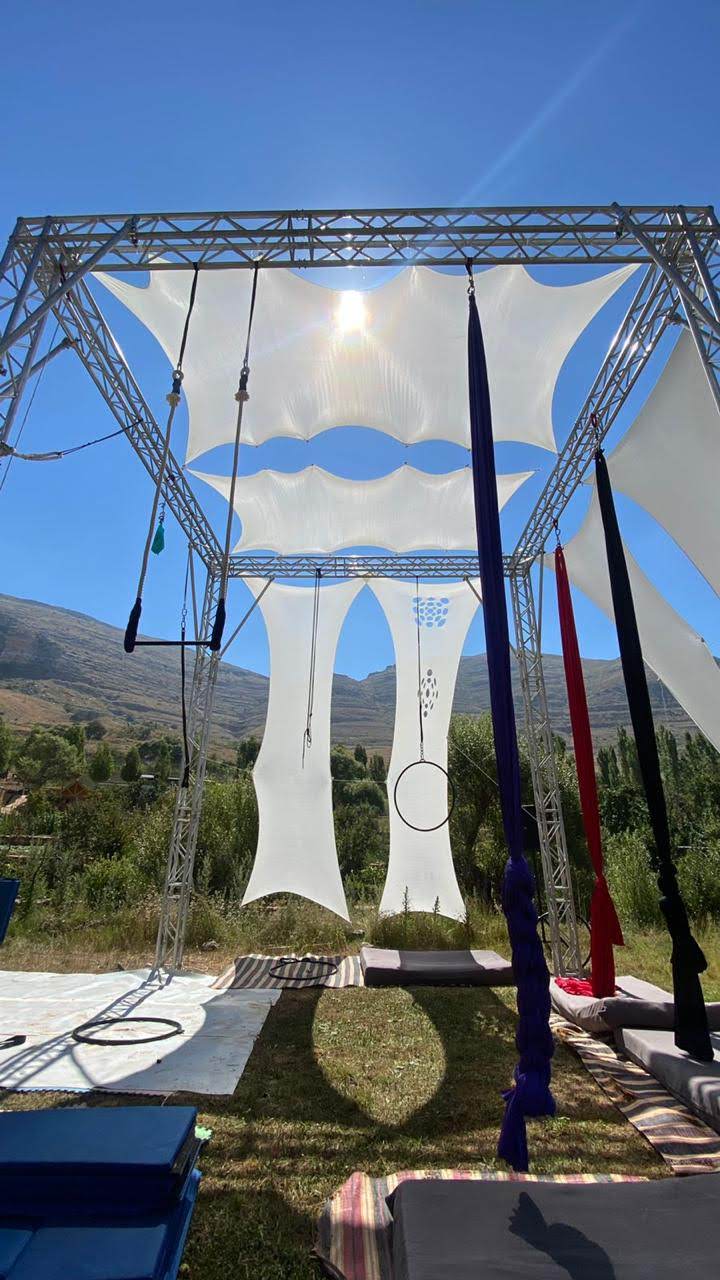
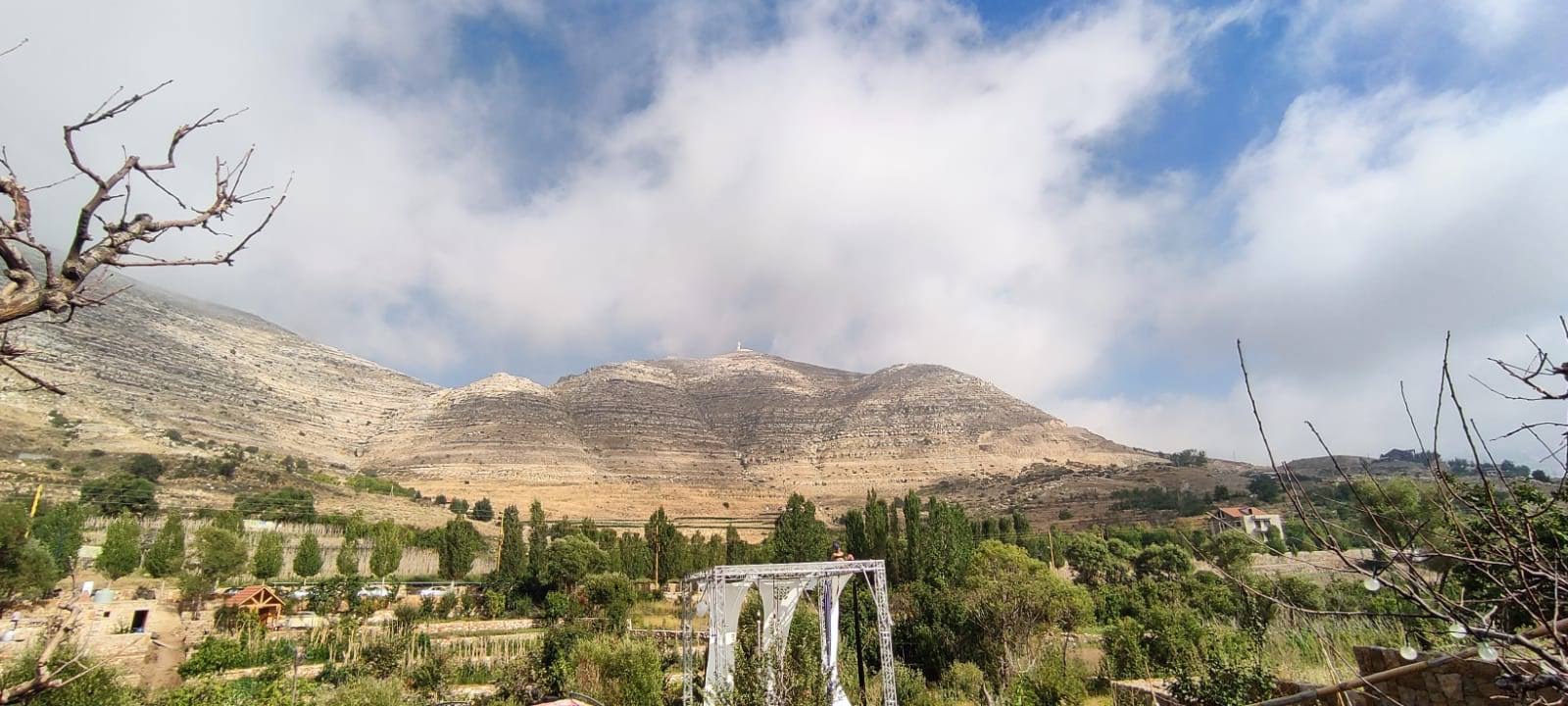
You can book a place in the shared rooms in the beautiful, spacious villa, or bring camping kit and pitch your own little patch of paradise in glorious gardens with a gorgeous mountain view.
Either way, there are shared bathrooms and showers, a large kitchen and plenty of living spaces. You’ll probably spend most of the time outdoors though.
There are three rooms available, one sleeps four, one takes eight people and the other sleeps 20. You’ll sleep on a fresh mattress with sheets and pillows supplied.
#### What should I bring?
1. US Dollars.
2. Your favourite snacks etc if you’ll struggle to get by without them.
3. Towel.
4. If you love your own yoga mat, then bring it, although there will be some available there.
5. Clothing suitable for LOTS of physical activities in this climate, and your skin type (ie do you burn easily?).
6. Whatever makes you happy! This is a festival, right? So bring your mojo!
#### What’s the weather like?
Fabulous! For that time of year, the average temperature hovers three or four degrees either side 30 degrees, and it’s dry heat, not humid.
#### It is safe to travel to Lebanon?
The tourist areas are safe, but it wouldn’t be your best idea to go near the borders with either Syria or Israel.
There are around 2.5 million tourists a year travelling to Lebanon, and it has some beautiful beaches, along with world-class cultural, natural and historic sites.
There may be some electricity outages but that’s to do with the economy and it’s usually resolved soon enough.
If you want to backpack around, [this website](https://www.thebrokebackpacker.com/is-lebanon-safe/) is quite useful.
#### Can I turn this into a beach holiday?
Absolutely! It’s an excellent place to enjoy the Mediterranean. Not only will you have a great time, you’ll be adding vital funds to the local economy.
You could try the following beach resorts: [Pierre & Friends](https://www.facebook.com/PierreAndFriendsOfficial/) at Batroûn, White Beach, [Edde Sands](https://www.eddesands.com/pdf/fact_sheet_EddeSands.pdf) in Byblos, [Janna Sur Mer](https://www.instagram.com/janna_sur_mer/) in Damour, [Joining](https://www.tripadvisor.co.uk/Attraction_Review-g1943861-d14067619-Reviews-Joining_Beach-Batroun_North_Governorate.html) in Batroun, and Sea Way.
#### What else is fun to do?
Gemmayze Street, Hamra Street, Mar Mkhayill Street and Mono Street in Beirut are filled with restaurants and bars.
For restaurants, try T Marbouta, the Grand Meshmosh, Em Sherif Café, The Village, Loris or Bar Tartine.
There are plenty of nightlife choices! Try Ballroom Blitz, Garten, Amelia Beirut, AHM, Grand Factory and BO18.
Raouchi is an upscale district of Beirut known for its cliff-side cafés which line Avenue de Paris.
There’s also plenty of cultural exploration in this historic country, known for its amazing climate, beautiful landscapes and the best food in the Middle East.
[Byblos](https://whc.unesco.org/en/list/295/), a UNESCO World Heritage Site. The ancient sea port is about 25km north of Beirut, which is one of the oldest continuously inhabited cities in the world.
[Jeita Grotto](http://jeitagrotto.com/grotto-jeita/) is a wonder of nature – two limestone crystallised grottoes stacked with stalactites and stalagmites which have been sculpted naturally in different shapes, sizes and colours over centuries.
[Baalbek](https://whc.unesco.org/en/list/294/), previously known as Heliopolis, is another UNESCO World Heritage Site where you will be amazed by some of the finest the archaeological remains of imperial Roman architecture. It’s about 65km from Beirut.
[Balou Balaa](https://theculturetrip.com/middle-east/lebanon/articles/what-makes-the-baatara-gorge-waterfall-in-lebanon-so-amazing/) is a massive waterfall at Baatara Gorge which drops 250m into a cave of Jurassic limestone, which has three natural bridges connecting it from side to side.
The mountain village of [Bcharre](https://www.lonelyplanet.com/lebanon/bcharre) is yet another UNESCO World Heritage site, where you can find rock-cut monasteries among the wild flowers and wildlife, and “the cedars of God” which has great religious and historical significance in the cultures of the Middle East, and is referenced many times in the literature of ancient civilizations.
There’s so much to see around [Batroun](https://www.tripadvisor.co.uk/Attractions-g1943861-Activities-Batroun_North_Governorate.html), including a Phoenician wall, a cathedral, fort, restored ancient manor house at a winery, and beach resorts including Joining, and Pierre and Friends.
You may think of [Harissa](https://www.cometolebanon.com/mount-lebanon/our-lady-of-lebanon-harissa) as a spicy sauce, but it’s also a key Christian pilgrimage site in Mount Lebanon, where you can find the shrine to Our Lady of Lebanon.
You can also try paragliding, and wine tasting which can be a great experience, especially at Anjar, Ksara and Kefraya.
Check out [Lebanon Traveler](https://www.lebanontraveler.com/) website for more.
#### Where can I stay in Beirut?
Meshmosh Hotel
Imm Nazih
Pool d’etats
Saifi Suites
Arthouse
O-Monot
There are also Airbnb options.
Further afield there’s Le Royal Hotel Beirut, Regency Palace Hotel or Burj on Bay
#### OK, I’m in! How do I book my pass?
Great! You can buy it via Paypal:
EU: judsin16@gmail.com
CA: levitate.leb@gmail.com
Interac also works, or use Western Union to Judy Salloum - Lebanon
#### Where can I donate to help with costs of Levitate not covered by tickets?
Thank you for thinking of this, every donation is gratefully received and will help circus to bloom in Lebanon and beyond. You can donate [here](https://www.gofundme.com/f/the-growth-of-circus-arts-in-lebanon).
#### How do I contact festival organisers if I need more info or help?
You can DM Judy Salloum via the Levitate Instagram page @levitate.lebKayAre you ready to Levitate? We certainly hope so! We’re stoked about this new collaboration for Aerial Edge and the Middle Eastern summer circus arts convention. You’re invited!